US-Mexico Border Death Map and Database
Fact Sheet and Notes on Database
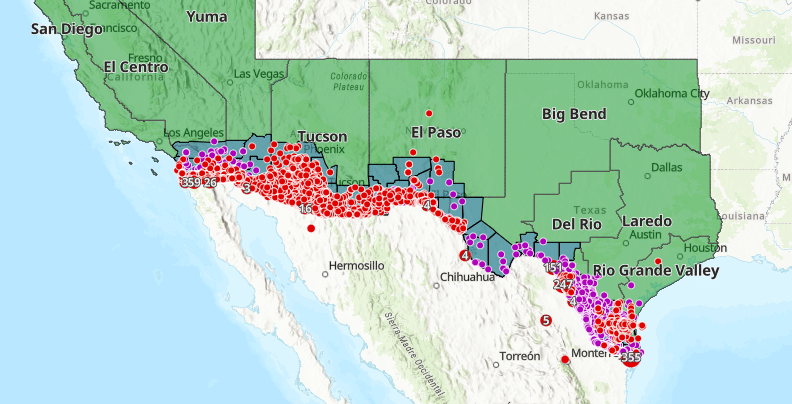
As we move into the hottest and deadliest months on the US-Mexico border, No More Deaths is releasing a comprehensive database and map of recovered migrant remains for the entire southern land border. This data will not bring anyone back or undo the decades of suffering and death caused by US border policy and perpetrated by the United States Border Patrol (USBP), and it does not account for the tens of thousands lost or missing in the borderlands—but it does provide the most comprehensive statistical record to date of people who died on their journey into the United States.
About the database
This database and map, which includes deaths from 2002 to the present (October 2026), compiles data from numerous sources: medical examiners, coroners, justices of the peace, and sheriff’s departments, as well as two of Border Patrol’s very flawed datasets. These sources provide varying levels of detail. At minimum, they record enough location and demographic data to compare cases with Border Patrol’s data. For California, New Mexico, and El Paso, we were able to obtain a much broader scope of data, including statistics for Border Patrol-involved deaths (wall falls, use of force, pursuit, in-custody, distress, etc), whether an individual had been seeking asylum or was a US resident, and other details. We will soon release similar data for Arizona. To respect the safety and privacy of families, we have anonymized personal identifying information for all cases. Additionally, many of these fields and data points are a work in progress, so the public database shared here is limited; a more complete dataset will be made available to journalists, researchers, and humanitarian and advocacy groups when requested. Please reach out to media@nomoredeaths.org for access, or to interview a member of our Abuse Documentation team.
CBP Undercount
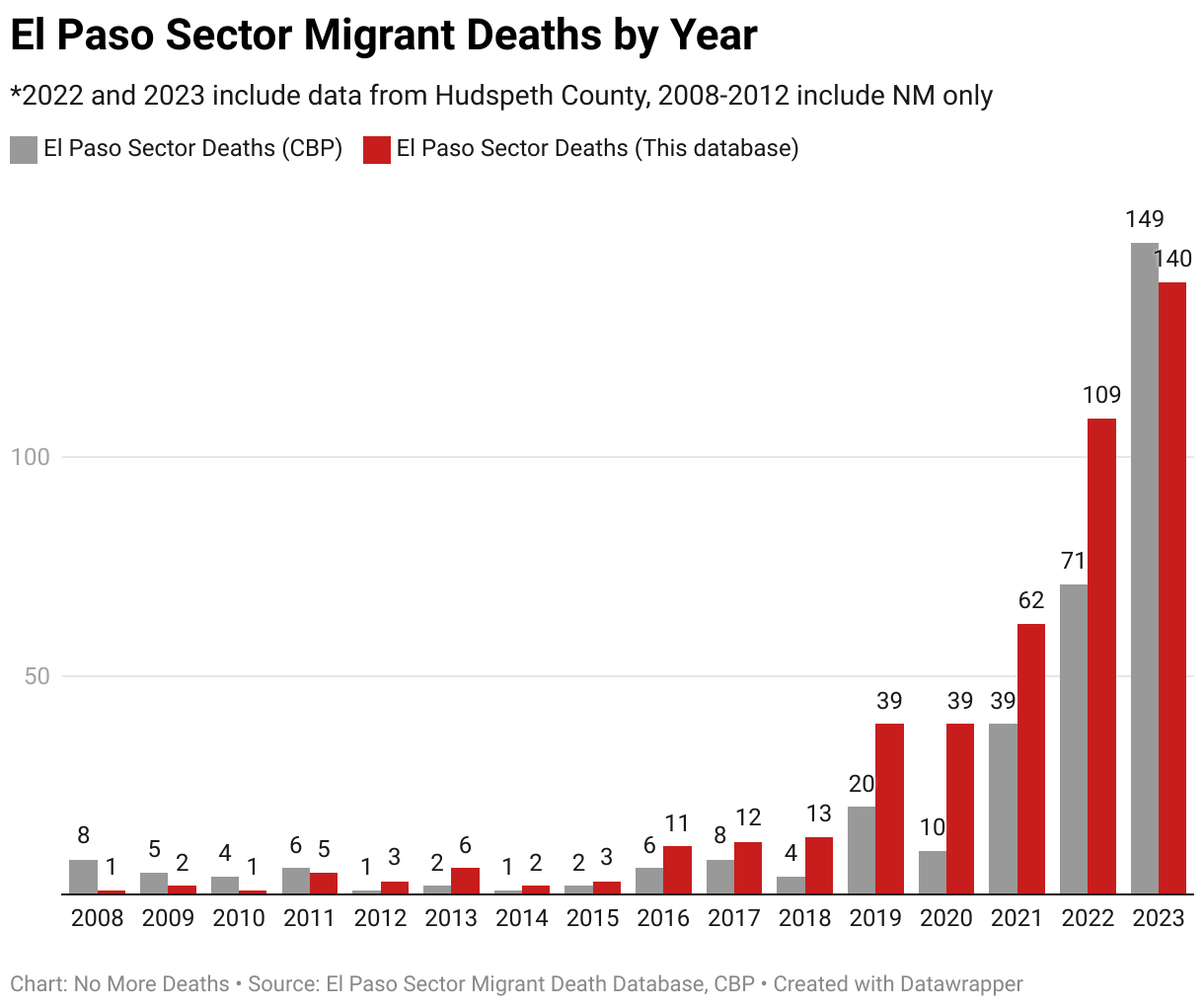
In our most recent report, published in March 2024, we showed how official CBP records undercount the deaths of people crossing the border in the El Paso Sector, as well as deaths caused by Customs and Border Protection (CBP) and other enforcement agencies. This new database compares deaths recorded by various sources on a person-by-person level, to show exactly how USBP undercounts deaths along the entire border. Depending on the sector under analysis, we document anywhere from 20% to 40% more migrant deaths than CBP’s official count. We also found that USBP makes regular errors when recording basic information such as name, age, nationality, and date of death. This raises serious questions about the ability of families to access information on their missing or deceased loved ones, and suggests that many do not receive notification of the deaths of their relatives.
Individuals who died in hospitals from injuries suffered while crossing the border were often not recorded by Border Patrol, which led many in-custody and other CBP-related deaths to be excluded from CBP’s data.
CBP Data Inconsistencies and Errors
Data from the Border Safety Initiative Tracking System (BSITS)—the CBP migrant death database that we used for comparison—is rife with inaccuracies, typos, and at times significant errors. This made any automated comparison impossible, due to the frequency of misspelled names, incorrect ages and nationalities, and inaccurate dates of death—errors so commonplace that we had to painstakenly compare each case with reference to the BSITS and our own database on a person-by-person basis.
Some of these mistakes appear inadvertent and, on their surface, may seem relatively harmless, such as typos, incorrect ages or dates, or duplicate cases. But when searching for data on an individual person, an incorrect name, age, or other identifying detail can mean the difference between identification and essentially being lost in the system. This has potentially serious consequences for families attempting to communicate with CBP or consulates, as well as for inter-agency communications and attempts to verify information, including whether a death even occurred.
Similarly, we have identified numerous cases in the BSITS data that have no corresponding entry in the medical examiner data, and in more than one case, in the entire Texas death registry for that year. Repeated FOIA requests seeking more information on each of these cases resulted in repeated denials, often justified by claiming that we could not prove that the person had died, despite the fact that the only reason we knew the person even existed in the first place was because of information provided by their database. In one case, in which a Haitian woman died due to miscarriage, the Haitian consulate was never even informed of the death, meaning that the family may also not have been notified. With no way to verify any of this information, these cases demonstrate an alarming level of negligence, callousness, and lack of communication among government agencies, raising serious questions about the integrity of in-custody death reporting and the possibility of state-sponsored enforced disappearance.
Causes of death reported by BSITS generally correspond with those provided by our other sources—but this is not the case when it comes to CBP-related deaths. Deaths caused by falls from the border wall, for example, are often miscategorized in a way that is difficult to interpret as anything but intentional: causes of death are changed to “exposure” or even “medical examiner undetermined” when the medical examiner had very clearly attributed the cause of death to a fall from the border barrier. When CBP—an agency that promotes itself in the public eye as humanitarian—is the main source of data for deaths caused by CBP, this represents an evident conflict of interest on the terrain of public relations. When the agency mislabels causes of death in this manner, it is effectively spreading misinformation and promoting a misunderstanding of the cause of deaths on the border, and of the deadliness of US border enforcement tactics.
This database shows how a reliance on CBP to record migrant death data (and to essentially investigate themselves for their own involvement in these deaths, through the agency’s Office of Professional Responsibility, or OPR), leads to an undercounting and miscategorization of incidents, and drastically misrepresents both the scale of deaths, the ways that migrants die (often at the hands of Border Patrol), and the changes in the demographics and circumstances of the victims. Medical examiners such as the Pima County Office of the Medical Examiner and, more recently, the New Mexico Office of the Medical Investigator, have taken up the task of flagging migrant deaths in the course of conducting death investigations. In early 2025, largely in response to organizing efforts by La Cruz Rosa, the Hope Border Institute (HBI) and informed by the El Paso Migrant Death Database as well as HBI’s report Making Migrant Death Data Count, El Paso County passed a resolution to address the migrant death crisis. Subsequent to this resolution, the El Paso County Office of the Medical Examiner began flagging migrant deaths as part of its death investigation process.

Border Enforcement deaths
Our data reveals how Border Patrol, already the deadliest federal law enforcement agency in the nation, misreports cases where they are involved. We recorded which deaths were caused directly by USBP or other border enforcement (For example wall falls, which are recorded by CBP but not technically USBP-related, or Texas Department of Public Safety, who has taken on many border enforcement duties and have begun causing large numbers of vehicle-related fatalities and injuries), using the same criteria as CBP’s own Office of Professional Responsibility (OPR), who is tasked with collecting data and reporting any CBP-related death (this includes deaths in custody, by pursuit, falls from the border barrier, use of force, and medical distress). With this data we can show that OPR failed to record the vast majority of these deaths, which has huge repercussions for public knowledge of CBP-related deaths, as well as any possibility of oversight or accountability.
For Yuma, San Diego, and El Paso sectors, we counted 21 deaths in custody, while the OPR reported only 3 (14% of the total); 87 deaths due to falls from the border wall, while the OPR reported only 17 (20% of the total); 81 deaths due to medical distress in cases involving USBP, compared to 34 reported by OPR (42% of the total); 68 deaths due to USBP pursuit by vehicle or on foot, of which only 13 were reported by OPR (less than 20%); and 8 cases in which a migrant was killed by USBP’s use of force, of which none were reported by OPR. As data from the Pima County Office of the Medical Examiner and the Imperial County Coroner become available, we will update this data to reflect those regions. Similar research in Texas will be necessary to provide a fuller accounting of deaths caused by CBP along the border.
For every person killed by a fall from the border wall, or in a vehicle following a pursuit by Border Patrol, there are many who are more injured, including many who suffer permanently debilitating injuries. The rate of these kinds of injuries and deaths has rapidly increased in recent years, and is sure to increase more with continued wall construction and the emboldenment of USBP to engage in deadly enforcement tactics with impunity. Too often, those injured in direct interactions with border enforcement are deported before receiving crucial medical care. The number of deaths we document in this database is therefore only the tip of the iceberg: many more people have died or become injured, or permanently debilitated, as a result of violence border enforcement and infrastructure.
Wall Falls
The bulk of wall-fall deaths have happened since Trump’s expansion of the border wall, beginning in 2017; accordingly, most of these deaths have occurred in San Diego County and the El Paso area, both urban areas with long stretches of new border wall construction since 2017.
With an increase in deaths comes an increase in serious injuries, although these are much harder to quantify. Some of the work of documenting injuries caused by the border wall has been done at the local level, by concerned doctors like Alexander Tenorio in San Diego and Brian Elmore in El Paso, who show how deaths from wall falls point to another underreported problem: the greater numbers of people who have become permanently disabled as a result of falling from the border barrier, or due to inadequate medical care or lack of medical care as a result of deportation. We have witnessed the results of some of these cases firsthand.
Falls from the US-Mexico border barrier are often miscategorized in CBP’s data, but they also routinely go unrecorded. While there is an element of uncertainty and deniability inherent to deaths involving agent pursuits, deaths due to falls from the border barrier generally have a very clear cause. So the fact that only a fifth of these deaths were recorded by OPR is extremely concerning, especially considering the cases where CBP fabricated the cause of death in the BSITS entry.
Pursuit
As NMD describes in Part One of our Disappeared report series, Border Patrol’s deadly enforcement methods result in many migrant deaths, including many of those recorded in this new database. Helicopters dust groups of migrants in the desert, forcing them to scatter and drop their water and other lifesaving supplies, or to become disoriented and separated from the other members of their group. Agents chase people on foot, causing people to develop heat stroke or become injured, or, in the case of the numerous canal and river crossings along the border, to get caught in the current and drown. Vehicle pursuits too often turn into mass casualty incidents, in which one or more people are killed and others are seriously injured. It’s not just the indifferent and deadly landscape, or the heat, that kill people, but the actions of USBP agents on the ground and in the sky.
Custody
Since 2022, the CBP’s Office of Professional Responsibility uses the definitions and guidelines provided by the Deaths in Custody Reporting Act of 2013 (DCRA) to report deaths in CBP custody. These include any deaths where a person is “[d]etained, under arrest, or is in the process of being arrested by any officer” of CBP, or is “[e]n route to be incarcerated or detained or is incarcerated or detained.” We used the same definitions in our own data collection process, but our analysis resulted in significantly higher numbers of deaths in custody. This could partly be explained by deaths attributed to “medical distress,” as we discuss below, and partly by deaths that occurred in hospitals (often with Border Patrol agents or security guards standing right outside the door).
Medical Distress
In its public relations and in its data, CBP has long blurred the line between “rescue” and “apprehension,” with the law enforcement duties of USBP agents often turning into “rescue” operations when encountering people in dire medical distress in the field. Border Patrol often uses the language of humanitarian benevolence to describe their role in these cases, which leads to an additional blurred boundary in the categorization of CBP-related deaths. In the OPR’s reporting, a “medical distress” death is one in which an agent is present during a migrant’s medical emergency that leads to that person’s death. There are cases in which an agent is arresting a person and then, as the individual succumbs to the effects of heat exposure, the agent becomes a first responder helping to rescue that person and the case is listed as a “rescue,” even though, per DCRA definitions, that person would be considered “in-custody.” In one case, the USBP agent on the scene made a point to say that a person who had died was not in custody, but merely “detained,” though again DCRA guidelines would describe this person as “in-custody” for reporting purposes.
Use of Force
OPR’s “use of force” category includes more recognizable deadly BP uses of force such as firearms, but also aggressive driving maneuvers such as ramming into a car that is being pursued, or the use of vehicle immobilization devices (VIDs) such as spike strips. None of the use of force cases we recorded in San Diego, Yuma, New Mexico, or El Paso were recorded or reported in the OPR database as such.
Asylum
Over the last ten years, the US government has steadily eroded access to asylum. In addition to the harms caused to vulnerable families and individuals stuck waiting on the Mexican side of the border, policies restricting asylum seekers’ access to ports of entry have also caused a crisis of death, disappearance, and suffering on the US side. This has been most notable in Eagle Pass, Texas, where hundreds of deaths began to be recorded in 2021 and 2022, but is also the case in southern Arizona, in the areas of Lukeville, Sasabe, and Yuma; in California, near Jacumba and Otay Mesa; in the city of El Paso, Texas; and elsewhere. Only very rarely have these situations appeared in the news within the context of asylum.
Information proving that a person was in the country and seeking asylum when they died is difficult to obtain, but our dataset confirms some of individual cases, and hints towards many others. Our analysis of demographic and location data shows that, over the past few years, there has been an increase in the deaths of migrants from countries not normally represented in migrant death data, who are more likely to be seeking asylum, especially countries in West Africa, South Asia, and South America.
Deterrence policies aimed at increasing the dangers of crossing the border have expanded and changed to apply to asylum seekers—a class of people by definition protected by international law. With the Trump administration’s attempts to block any access to asylum at the southern US border, we are sure to see increases in deaths of more vulnerable populations, as well as harder to quantify consequences for people unable to flee dangerous situations in their home countries, or stuck in perilous circumstances in a third country.
US Residents
Investigators’ reports for some counties contained information that allowed us to determine whether a decedent had been a US resident. In San Diego, especially, we found evidence that many US residents had died while attempting to cross back into the country. These ranged from people who had travelled to Mexico to visit family and had to make a difficult desert crossing to return home, to people who died after a very recent deportation to a place where they likely had few or no connections. In some cases, a spouse, child, or other family member of the person who died became part of the search party, looking for their missing loved one when Border Patrol refused to initiate a timely search.
The data from this field is very limited—we were able to confirm the residency status of few individuals, and usually only anecdotally—but the information we do have shows one of the many ways that deportation and the lack of legal pathways to regularization of residency can be a death sentence.
Mexico
We made multiple records requests to medical-legal authorities in northern Mexico, with varied results. Most of this data does not appear in our visualization, as it is incomplete and further requests and analysis will be necessary before it is usable for our purposes. The one exception is death data recorded by Grupos Betas, a network of humanitarian aid groups administered by Mexico’s National Institute of Migration (INM).
These records confirm a 2024 study by Lighthouse Reports detailing how CBP significantly undercounts migrant drownings in the Rio Grande. When including remains found on the Mexican side of the Rio Grande—remains that were often the result of Border Patrol agents or Texas National Guardsmen pushing migrants back into the river—the real death count is much higher.
Without deeper research into deaths on the Mexican side of the border, we are left with an incomplete account of the human cost of U.S deterrence policies.
Recommendations
The death toll from thirty years of Prevention Through Deterrence border policy is staggering. The death of each person listed in the database here, as well as the thousands more who died in Mexico or in a place where data was unavailable or difficult to access, and the likely tens of thousands more whose remains were never found, who disappeared in remote areas of the border, is a tragedy directly caused by increasingly violent US border enforcement and immigration policies, and by the actions of Border Patrol, an agency that has proved time and again that it cannot be reformed. We therefore call for the end of Prevention Through Deterrence and the abolition of the United States Border Patrol, an agency directly and indirectly responsible for the deaths of tens of thousands of people.
We also call for the abolition of Immigrations and Customs Enforcement (ICE), which has been empowered and emboldened to create and invisibilize more and more of the harms described here.
To ensure that human rights and international law are respected, we echo our open letter of December 2023 in calling for ports of entry to be reopened to asylum seekers. We must also reopen legal asylum pathways which are our responsibility under international law and decades of precedent.
At a minimum, we urge medical examiners, justices of the peace, and coroner’s offices to follow the lead of the Pima County Office of the Medical Examiner, the New Mexico Office of the Medical Investigator, and the El Paso Office of the Medical Examiner in recording migrant deaths. This would go a long way towards creating an alternative to the highly flawed CBP database, and toward ensuring accountability and promoting better understanding of individual causes of death, and of the crisis of mass border death more broadly.
We’ve pointed at just a few preliminary findings from the large amount of data collected in this database. We hope others can use the database as a resource for continued research, advocacy, and direct aid.
Charts of CBP Yearly Undercount